
Why Your Crystal Combinations Might Be Doing More Harm Than Good
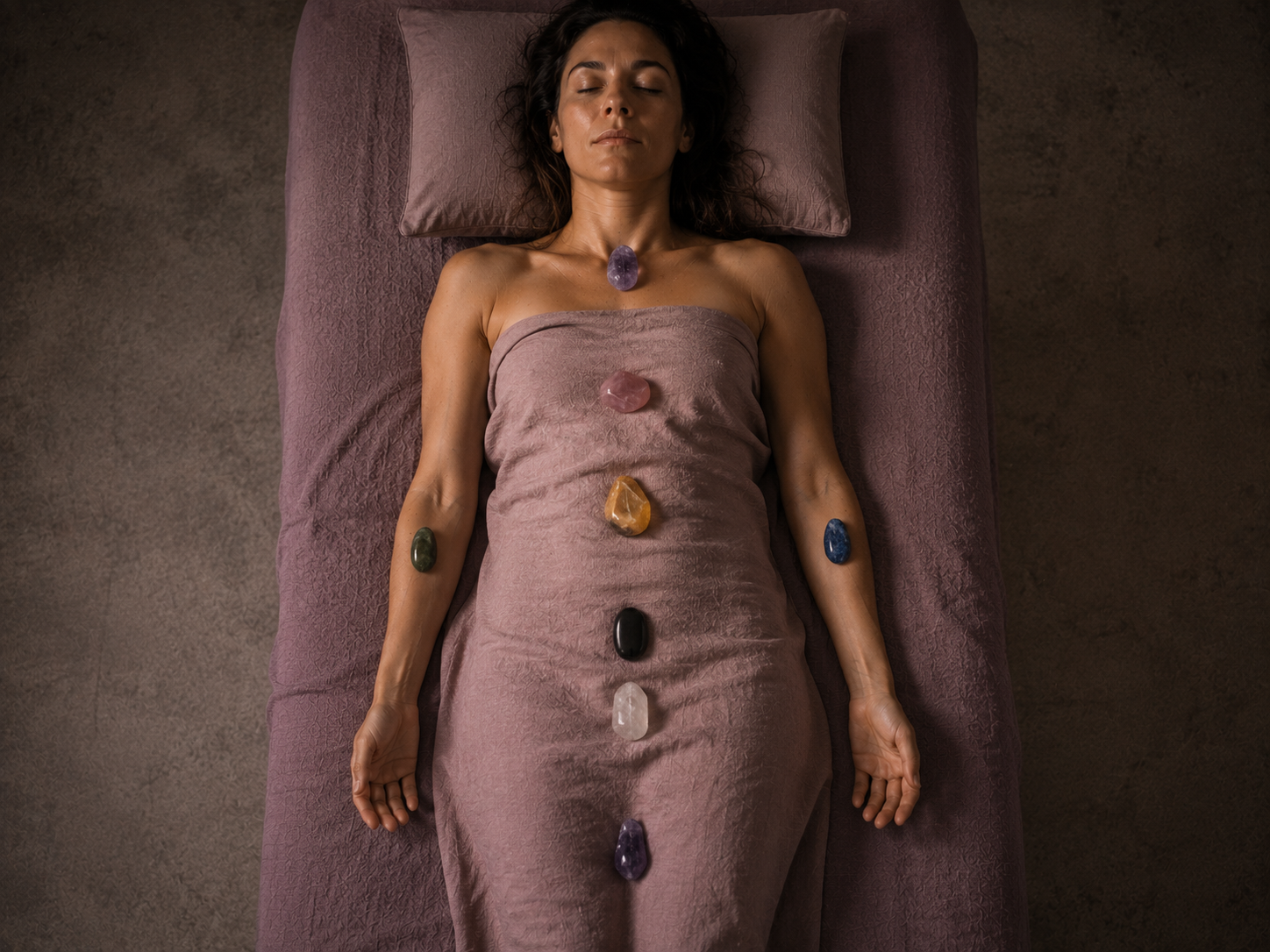
Here is something most crystal education will never tell you.
The most advanced and most dangerous aspect of crystal therapy is not which stone you choose. It is what happens when you put multiple stones together on the same person at the same time.
Single stone work has a relatively contained risk profile. You introduce one frequency, it interacts with one field, and the effects — while real and significant — are generally manageable. You can read the response. You can remove the stone.
You can adjust.
Multi-stone layouts are a different conversation entirely.
When you place several crystals on a client simultaneously, you are not simply delivering the combined benefits of each individual stone. You are creating a new energetic field — one shaped by how those frequencies interact with each other, with the client's current state, and with the specific configuration you have created. That field can be profoundly supportive. It can also be incoherent, conflicting, or simply too much for the nervous system in front of you to receive safely.
Most practitioners designing multi-stone layouts were never taught this. They were taught what each stone does individually and left to assume that combining good stones produces a good result. That assumption is incomplete. And when it goes wrong — when a layout creates conflict rather than coherence, when it amplifies what should have been left alone, when it opens things the session was not equipped to hold — the client pays the price.
This is the conversation crystal therapy needs to have. And it starts here.

The Gap Nobody Talks About
Walk into almost any crystal therapy training and the curriculum follows a predictable structure. You study individual stones — their properties, their chakra associations, their general energetic qualities. You learn placement basics. You learn how to set intentions and cleanse your tools. And if the training is thorough, you learn something about reading clients and assessing their needs.
What almost no training covers in any meaningful depth is frequency compatibility — what happens when two or more stones are placed together, how their energies interact, what the combined field they create feels like for the client's nervous system, and which combinations should never be used on a dysregulated, trauma-carrying, or unprepared system regardless of how beautiful they look together.
This gap is not accidental. It is a natural consequence of how crystal knowledge has been transmitted in the mainstream wellness space — through books that catalog individual stones, through workshops that teach properties and placements, through practitioners who learned from practitioners who learned the same incomplete curriculum.
The result is a generation of crystal therapists who are skilled at selecting stones individually and almost entirely untrained in the dynamics of combination work. Who design layouts based on what feels energetically interesting, what looks balanced on the body, or what their intuition draws them toward in the moment — without the foundational understanding of how the frequencies they are combining actually interact with each other and with the person beneath them.
That is not a criticism of individual practitioners. It is a description of a systemic education failure. But understanding it is the first step toward doing something different.

What Is Actually Happening When You Combine Crystals
To understand why combination work requires its own body of knowledge, you need to understand what is actually happening energetically when multiple stones occupy the same field simultaneously.
Each crystal carries a distinct vibrational frequency. When crystals are placed near each other and near a human body, their frequencies do not simply coexist independently. They interact. They influence each other. The combined field they create is shaped by the relationship between those frequencies — and that relationship can produce one of three broad results.
The frequencies can harmonize — resonating in a way that creates a coherent, unified field that is greater than the sum of its parts. Harmonious combinations feel cohesive to the client's nervous system. The body does not have to work to reconcile conflicting energies. It can simply receive the unified field and respond to it.
The frequencies can conflict — pulling in different directions, creating an incoherent field that the client's nervous system has to work against rather than with. Conflicting combinations do not necessarily feel dramatic from the outside. The client may not be able to name what feels off. But their body is spending energy managing the incoherence of the field rather than using that energy for healing. The session becomes less effective at best and actively disruptive at worst.
Or the combined frequencies can become simply overwhelming — too much activation, too much amplification, too much movement for the nervous system in front of you to receive safely. Overwhelming combinations do not require conflicting stones. They can be created entirely from stones that are individually supportive but collectively too powerful for a client whose capacity is limited, whose nervous system is already activated, or whose emotional field is carrying more than usual.
Understanding which of these three outcomes a combination is likely to produce — before it goes on a client — is the foundational skill of multi-stone layout work. And it is a skill that requires real study, not just intuition.
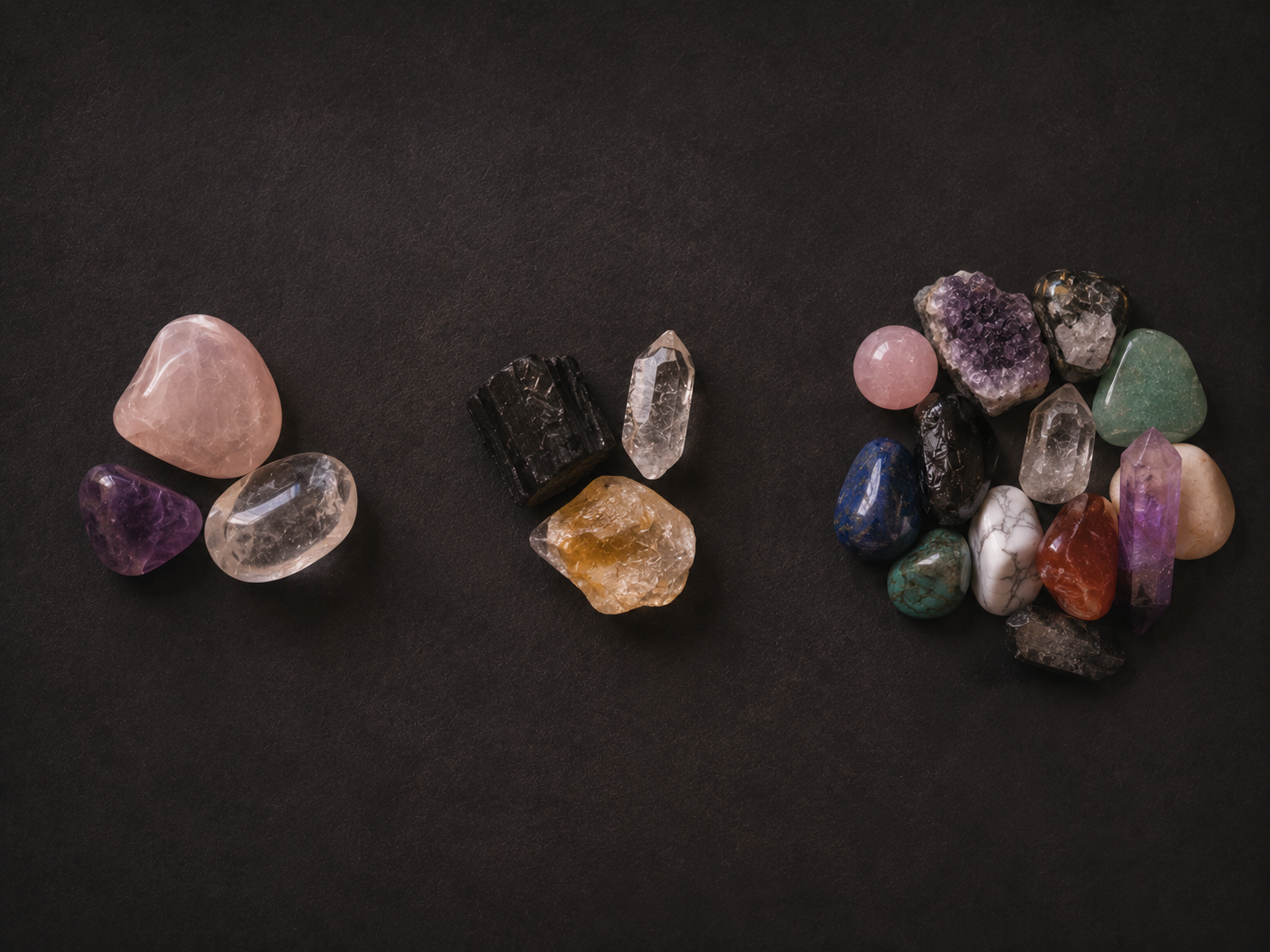
The Three Types of Crystal Combinations
Not all crystal combinations are created equal. Here is a practical framework for thinking about combination work that you can apply directly to your session design.
Harmonious combinations are the foundation of good layout design. These are pairings and groupings where the frequencies complement each other — where one stone's qualities enhance or support another's, creating a field that moves coherently toward a shared intention. Harmonious combinations feel integrated to the client. The effects build on each other rather than competing. The nervous system can receive the whole layout without having to manage internal conflicts within the field.
Identifying harmonious combinations requires understanding not just what individual stones do but how their specific qualities interact. Two grounding stones can create deep stability or redundant heaviness depending on which stones they are. A grounding stone paired with a gentle heart opener can create the safe container for emotional work. The same grounding stone paired with a high-frequency activator might create a split in the field where the client's system is simultaneously being pushed upward and anchored downward — which is not a therapeutic experience, it is a confusing one.
Conflicting combinations occur when frequencies pull in opposing directions. The clearest version of this is a direction conflict — one stone moving energy upward while another moves it downward, one stone clearing outward while another pushes inward. But conflicts can also arise between stones with opposing energetic qualities — one that calms and one that activates, one that opens and one that protects through contraction, one that invites emotional material to surface and one that consolidates and holds things in place.
Conflicting combinations are particularly insidious because their effects are often subtle and hard for the client to articulate. They do not usually produce dramatic distress. They produce a low-grade sense of unsettlement, a feeling of being worked against rather than supported, an exhaustion after the session that goes beyond normal integration fatigue. Clients often attribute this to "the healing being intense" when it is actually the result of a layout that was working against itself.
Overwhelming combinations are the most acutely dangerous category. These are layouts where the combined frequency load exceeds the capacity of the nervous system to receive safely — not because the stones conflict, but because there is simply too much happening at once. Multiple high-frequency stones. Multiple amplification stones. Multiple stones that initiate opening or release. Combinations that might be entirely appropriate for an experienced, regulated, well-resourced practitioner working on their own field can be genuinely destabilizing for a client who came in carrying stress, grief, trauma, or any of the ten thousand things that keep a nervous system running hotter than its baseline.
The client does not need to be in obvious distress for an overwhelming combination to cause harm. They just need to be more activated than their system can safely process along with a powerful multi-stone layout. And most clients are operating with at least some degree of background activation, most of the time. Which means the question of whether a combination is too much is never a theoretical one. It is always specific to this person, on this day, with everything their system is already carrying.

The Most Common Combination Mistakes Practitioners Make
With that framework in mind, here are the patterns that show up most consistently when crystal combination work goes wrong.
Pairing high-frequency activation stones with clients who need grounding first. This is the single most common mistake in multi-stone layout design. High-frequency stones — those associated with the upper chakras, with spiritual activation, with accelerated energy movement — require a stable, grounded foundation to work safely. When they are placed on a client whose lower energy centers are unstable, whose nervous system is dysregulated, or who does not yet have the internal resources to hold what gets activated, the result is frequently overwhelm, dissociation, or a destabilization that persists long after the session ends.
The principle ground before open is not a rule that applies to certain clients in certain circumstances. It is a governing principle that should inform every multi-stone layout you design. If the foundation is not stable, introducing upper-level activation does not help the client ascend. It disconnects them from the ground they needed to stay safe.
Combining multiple amplification stones without assessing what they might amplify. Clear quartz is the most commonly used example — a stone so frequently present in multi-stone layouts that its amplification quality is almost taken for granted. Add a second amplifying stone, or a third, and the amplification effect compounds. Whatever is present in the client's field gets turned up — including everything they came in carrying that has not yet been processed. Grief. Anxiety. Anger. Trauma responses held just below the surface. Amplification does not select for the pleasant and skip over the difficult. It amplifies what is present.
Using upper chakra stones before lower chakra stability is established. Third eye and crown chakra activation is among the most sought-after experiences in crystal therapy — and among the most frequently introduced without the preparation it requires. Sustainable access to upper chakra experiences requires a coherent, stable foundation in the lower energy centers. Without that foundation, upper chakra activation produces spiritual experiences that the client cannot integrate, perceptions they cannot ground, and a sense of disconnection from physical reality that can be profoundly disorienting.
Mixing clearing and opening frequencies without understanding the sequencing. Clearing stones and opening stones serve related but distinct functions — and using them simultaneously or out of sequence creates a situation where the client is being asked to release and receive at the same time, which is not how most nervous systems work well. Clearing first, then creating space, then introducing what you want to invite forward — this is a sequence that honors how the system actually processes experience. Collapsing that sequence into a simultaneous layout is not more efficient. It is less coherent.
Designing layouts based on aesthetic harmony rather than energetic compatibility. This is the most honest one to name and the most important. A layout that looks beautiful on the body — stones spaced evenly, colors balanced, the visual symmetry satisfying — may have nothing to do with energetic coherence. The eye is not a frequency instrument. What looks harmonious and what is harmonious are not the same thing. And designing for the former while claiming to deliver the latter is one of the most common ways crystal therapy drifts from therapeutic practice into decorative performance.

Direction Conflicts — The Most Overlooked Problem
Of all the factors that determine whether a crystal combination is safe and effective, direction of energy movement is the most consistently overlooked. Most practitioners understand that different stones have different properties. Far fewer understand that those properties include a directional quality — a tendency to move energy in a specific way through and around the body — and that combining stones with conflicting directional qualities creates a kind of energetic tug-of-war that the client's system has to resolve.
Some stones move energy upward — toward the crown, toward expanded consciousness, toward the surface of the body and the upper field. Some move energy downward — toward the earth, toward the lower body, toward the stabilizing pull of physical reality. Some draw energy outward from the body — clearing, releasing, extracting what has accumulated. Some push energy inward — consolidating, protecting, creating density and containment.
When you place a stone that moves energy upward alongside a stone that moves energy downward, you are creating a directional conflict within the layout. The client's nervous system has to navigate two simultaneous directives that are pointing in opposite directions. This is not a neutral experience. It is a confusing one — and it produces exactly the kind of low-grade unsettlement that clients experience after sessions that were meant to help but somehow left them feeling more fragmented than when they arrived.
Direction conflicts are particularly hard to detect during a session because they do not usually produce obvious signs. The client may seem relaxed. They may report a pleasant experience. The effects of the conflict often show up hours or days later — in a sense of persistent ungroundedness, in emotional volatility, in difficulty sleeping, in a vague feeling that something has been stirred up without being settled.
Learning to map the directional quality of the stones you use most frequently is one of the highest-leverage investments you can make in the quality of your combination work. It is not complicated knowledge. But it is knowledge that requires deliberate study rather than intuitive assumption.
The Amplification Problem in Combination Work
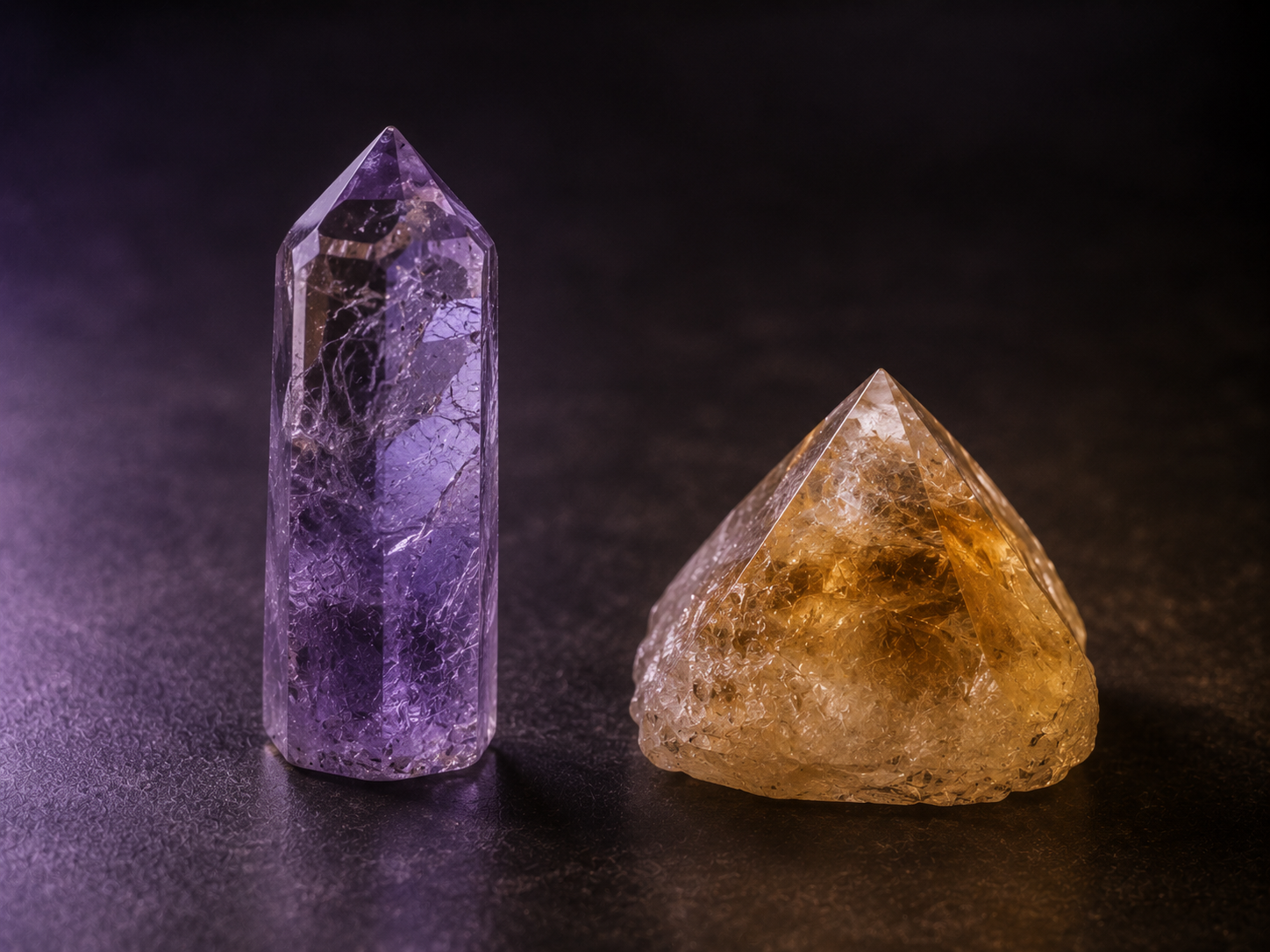
Amplification stones deserve their own extended conversation in the context of combination work because they behave so differently in a multi-stone context than they do when used alone.
A single amplification stone placed on a client introduces an upward pressure on whatever is present in the field. Used thoughtfully on a prepared client, this produces enhanced receptivity and accelerated movement through the session's intention. Used without assessment on a client carrying significant unprocessed emotional material, it can intensify exactly what was hoped to be released.
Now put two amplification stones in the same layout. The amplification effect does not simply double — it compounds. The two stones amplify each other as well as the client's field. The overall frequency load of the layout increases significantly. And the question of what is present in the client's field to be amplified becomes considerably more urgent.
Put three amplification stones in the same layout — which happens more often than it should — and you have created a situation where the threshold for safe use is very narrow indeed. Only a client with an exceptionally regulated nervous system, significant experience receiving energy work, and no significant unprocessed emotional material in their current field is likely to benefit from that level of amplification without being overwhelmed by it.
The problem is not that amplification stones should not be used in combination work. They absolutely can be — with knowledge, with assessment, and with a clear understanding of how they interact with the other frequencies in the layout and with the specific person receiving it. The problem is when they are used without that understanding, because they feel powerful, because the combination seems energetically interesting, or because they have become such default presences in crystal layouts that their amplification quality is no longer being actively considered.
Anytime you are designing a multi-stone layout, count your amplification stones and ask yourself deliberately: what might this combination amplify in this client today? And is this person's system resourced enough to receive that amplification safely?

Sequencing — The Dimension Most Practitioners Ignore
Layout design is not only about which stones. It is about the order in which they are placed, the order in which they are removed, and the arc of frequency movement that the session creates from beginning to end.
Most practitioners think about sequencing in terms of the session structure — intake, treatment, integration, close. Far fewer think about sequencing in terms of the frequency arc within the treatment itself — how the combination of stones builds, moves, and resolves over the course of the session, and how each placement decision affects what is possible in the placements that follow.
The foundational principle here is one that applies to virtually all energy and somatic work: establish safety before depth, ground before open, create the container before inviting anything forward.
In crystal layout terms, this means beginning with stones that stabilize and regulate the nervous system before introducing stones that activate, open, or accelerate. It means building the lower chakra foundation before working with the upper chakras. It means creating coherence in the field before amplifying what is present in it.
This sequence is not arbitrary. It reflects how the nervous system actually processes experience. A system that is grounded and stable can receive and integrate far more than a system that is already activated. The stones you place at the beginning of a session are not the support act for the real work that comes later. They are the foundation that makes the real work possible.
Removal sequencing matters equally. The order in which stones are removed at the end of a session affects how the client's system closes and integrates. Leaving high-frequency activation stones in place while removing grounding stones, for example, can leave a client energetically unanchored at the close of the session — activated without the foundation needed to hold what was opened. Closing a layout thoughtfully, in a sequence that grounds and settles before it concludes, is as important as the opening design.

How to Know If a Combination Is Working or Causing Harm
The most important skill in multi-stone layout work is not design — it is the ability to read a client's real-time response to a combination and adjust accordingly.
When a combination is working well, the body communicates it clearly. The breath deepens and slows. The muscles soften. The face releases tension. The overall quality of the client's presence shifts from doing to being. There is a settledness in the body that is distinct from sleep or dissociation — a quality of alert, receptive stillness that indicates the nervous system is responding well to the field that has been created.
When a combination is creating conflict or overwhelm, the signs are subtler but equally real. Look for a slight tightening across the chest or shoulders that was not there before a stone was placed. Watch for the breath becoming shallower rather than deeper. Notice changes in the face — a furrowing, a subtle holding, a quality of internal effort rather than release. Pay attention to small movements — the hands closing, the feet shifting, the jaw tightening — that suggest the system is managing something rather than receiving it.
The most important thing to understand about these signs is that most clients will not report them verbally. They will lie quietly, telling themselves that discomfort is part of healing, that they should push through, that they do not want to be difficult. The practitioner's responsibility is to read the body rather than waiting for the client to speak — and to act on what the body is communicating even when the client has not put it into words.
Acting on it might mean removing a stone that is creating conflict. It might mean adjusting the layout to add grounding before continuing. It might mean slowing the session down entirely. It might mean ending the formal crystal work and simply holding space for the client to settle. What it never means is continuing with a combination that the client's body is clearly struggling with because you believe it is what they need.
Building a Protocol Library You Can Actually Trust
All of this points toward a single practical direction: moving from intuition-only combination design toward a practice grounded in real knowledge of frequency compatibility.
This does not mean abandoning intuition. Intuition is a genuine and valuable practitioner skill — the ability to sense in real time what a client needs, to feel which stones want to be together, to notice the energetic quality of a combination as you design it. That capacity is worth developing and trusting.
But intuition is most powerful when it is operating on a foundation of knowledge. When you understand how crystal frequencies interact, when you know the directional qualities of your most-used stones, when you have studied which combinations harmonize and which conflict — your intuition becomes a refinement tool operating within a structure of real understanding. That is a far more reliable guide than intuition alone, especially in the complexity of multi-stone work.
Start by building your knowledge of the stones you use most frequently. Not just their properties — their directional qualities, their speed, their amplification characteristics, their contraindications in combination. Study frequency compatibility systematically, using multiple sources and testing your understanding in your own field before applying it to clients.
Test new combinations on yourself before introducing them in sessions. Your own body is the most honest feedback system available to you. A combination that creates coherence will feel different in your own field than one that creates conflict. Learning to recognize that difference experientially — not just conceptually — is irreplaceable.
Build a core library of trusted layouts for your most common session intentions — grounding and regulation, gentle emotional support, heart opening, energetic clearing, spiritual connection — and refine them over time based on what you observe in your client work. A protocol library built on real knowledge and real observation is one of the most valuable assets a crystal practitioner can develop.
And be honest with yourself about your current level of experience. Some combinations require a level of practitioner skill and client assessment capacity that takes years to develop. Working within your genuine range — and building outward from there deliberately rather than jumping to complexity before the foundation is solid — is not a limitation. It is exactly what integrity in this work looks like.
Scope of Practice in Combination Work
The more complex the crystal combination, the more advanced the assessment skills it requires. This is a simple truth that has significant implications for how practitioners approach multi-stone layout design — and for what they do when something unexpected happens in a session.
Advanced combination work involving high-frequency stones, multiple amplification elements, or deep trauma support protocols requires a practitioner who can read the nervous system in real time with significant accuracy. Who can detect the subtle signs of overwhelm before they become acute. Who can adjust mid-session without losing the therapeutic thread. Who knows when to stop entirely and how to close a session safely when something has opened that the session is not equipped to hold.
These are skills that develop over time and with deliberate attention. They cannot be assumed from enthusiasm, from intuition, or from comfort with the stones themselves. And working with combination complexity beyond your current assessment capacity is not adventurous. It is a risk transferred entirely onto your client.
When a layout opens something unexpected — when a client begins to access traumatic material, when a strong emotional response arises that the session structure cannot safely hold, when the nervous system signals distress rather than receptivity — the responsible path is always the same. Slow down. Remove what needs to come off. Ground first. Check in with the client. And if what is present exceeds your scope — if this is clinical trauma territory, if this is a mental health crisis, if this is something that requires the container of a licensed therapist — say so clearly and refer without apology.
Restraint in combination work is not caution born of fear. It is wisdom born of genuine understanding. The practitioners who work most powerfully with multi-stone layouts are not the ones who use the most stones or design the most elaborate configurations. They are the ones who know exactly why every stone in their layout is there — and who are confident enough in that knowledge to use far less than they could, because less done well is always more than more done without full understanding.

The Standard This Work Deserves
Multi-stone crystal layouts are not an intermediate skill that practitioners graduate into after mastering individual stone work. They are a distinct discipline with their own body of knowledge, their own assessment requirements, and their own risks when practiced without genuine understanding.
The clients who lie on your table and receive your layouts are trusting you with something real — their bodies, their nervous systems, their emotional fields, their capacity to feel safe in a healing space. They cannot assess for themselves whether the combination you have designed is appropriate for their current state. They do not know whether the stones you have placed are working with their system or against it. They are relying entirely on your knowledge, your discernment, and your commitment to their wellbeing over your attachment to a particular way of working.
That is an enormous responsibility. And it deserves to be held with the seriousness it requires.
Not every combination that feels interesting is appropriate. Not every layout that looks beautiful is coherent. Not every multi-stone configuration that your intuition draws you toward is one that the client in front of you — with everything their nervous system is carrying today — can safely receive.
The difference between a practitioner who designs layouts because they feel right and one who designs them because they understand them is felt by every client on the table. In how deeply they can receive. In how safely they integrate. In how they feel not just after the session but in the days that follow. In whether they come back.
Build the knowledge. Do the study. Learn your stones at a level that goes beyond their associations. Understand the field you are creating before you invite another person to receive it.
That is what this work deserves. That is what your clients deserve.
And it is exactly the standard that Deva Moon Academy is built to help you reach.
At Deva Moon Academy, crystal combination work is taught as a complete discipline — covering frequency compatibility, directional qualities, amplification dynamics, sequencing, and real-time client assessment. If you are ready to build a crystal practice that operates at this level of knowledge and integrity, our free Practitioner Guide is where we start. Link in bio.
